

SD card vs cloud connected dashcam
article by Jamie Drummond – Sales Manager, Fleetloc8, the Fleetmaxx Tracking Solution
Key Takeaways
- SD card dash cams store footage locally and offer a simple, cost effective solution for many fleets.
- Cloud connected cameras provide remote access to footage and faster incident response.
- Both technologies have advantages and limitations depending on how your fleet operates.
- Many modern systems combine local storage with live connectivity.
- Multi camera systems can provide full vehicle visibility and help reduce blind spots.
- The right choice depends on your fleet’s risk profile, operating area, budget and visibility requirements.
Fleet dash cams have become an increasingly important tool for businesses looking to improve safety, reduce insurance disputes and gain greater visibility over their vehicles.
In recent years, cameras have evolved from simple recording devices into intelligent fleet management tools that can support driver coaching, incident investigation and compliance.
But when choosing a camera system, there is one main thing to consider:
Should you choose an SD card dash cam or a cloud connected camera?
The answer depends on how your fleet operates.
While both systems record valuable footage, they store and access that footage in very different ways.
Understanding those differences can help businesses choose the right solution for their vehicles, drivers and operational requirements.
What is an SD card dash cam?
An SD card dash cam records footage locally onto a removable memory card installed within the camera itself.
As the vehicle operates, footage is continuously recorded and stored on the card. Most commercial systems use loop recording, meaning that once storage capacity is reached, the oldest footage is automatically overwritten.
Important events, such as collisions or harsh driving incidents, can often be locked to prevent them from being deleted.
To access footage, users typically remove the SD card from the device or download files directly from the camera.
SD card systems remain popular because they offer:
- Reliable video recording
- Lower ongoing costs
- Simple operation
- High quality evidence capture
- No reliance on mobile connectivity
For many fleets, local storage provides everything they need to investigate incidents and support drivers when required.
View FleetCam, our SD Card Dash Cam
What are the advantages of SD card dash cams?
One of the biggest benefits of SD card systems is simplicity.
Because footage is stored locally, businesses avoid the ongoing data costs associated with cloud uploads. This can make SD card cameras a cost effective option for fleets operating multiple vehicles.
Local recording also means footage continues to be captured even in areas with poor mobile coverage, which can be particularly useful for rural operators or businesses working in remote locations.
For many SMEs, trades and local delivery fleets, SD card systems provide a practical balance between security, visibility and affordability.
What are the limitations of SD card dash cams?
While highly effective, SD card systems do have some limitations.
Retrieving footage often requires physical access to the vehicle, which can slow investigations if vehicles operate remotely or spend long periods away from base.
For example, if an incident occurs hundreds of miles away, businesses may need to wait until the vehicle returns before accessing the footage.
There is also the possibility of SD cards becoming damaged or removed, although modern commercial dash cams are designed to minimise these risks.
For businesses requiring immediate access to footage, this delay may be an important consideration.
What is a cloud connected dash cam?
Cloud connected dash cams use mobile data networks to upload footage remotely to secure servers.
Instead of physically retrieving an SD card, authorised users can access footage through an online portal or mobile app.
Depending on the system, footage may upload continuously or only when specific events occur, such as:
- Harsh braking
- Speeding
- Collisions
- Driver alerts
- Manual activation
This allows fleet managers to access important footage quickly, regardless of where the vehicle is operating.
View FleetCamLive! Our live footage dash cam
What are the advantages of cloud connected cameras?
Cloud connected systems provide a higher level of visibility and control.
Businesses can:
- Access footage remotely
- Investigate incidents faster
- Receive real time alerts
- Support lone workers
- Improve operational visibility
- Monitor fleets from almost anywhere
For businesses managing national fleets or high value vehicles, rapid access to footage can significantly reduce investigation times and support insurance claims.
Remote access can also help businesses respond more quickly to customer complaints, disputes or operational issues.
In many cases, faster access to footage means faster decision making.
What are the limitations of cloud connected cameras?
Cloud connected systems also have considerations.
Because footage is uploaded using mobile networks, these solutions typically involve higher ongoing costs compared to local only recording.
Upload speeds may also vary depending on mobile coverage and the amount of data being transmitted.
Some systems upload only event triggered footage rather than continuous video, helping to balance visibility with data usage.
For many fleets, the additional investment is worthwhile, but businesses should consider their operational requirements before choosing a solution.
SD Card vs Cloud Dash Cams: What’s the difference?
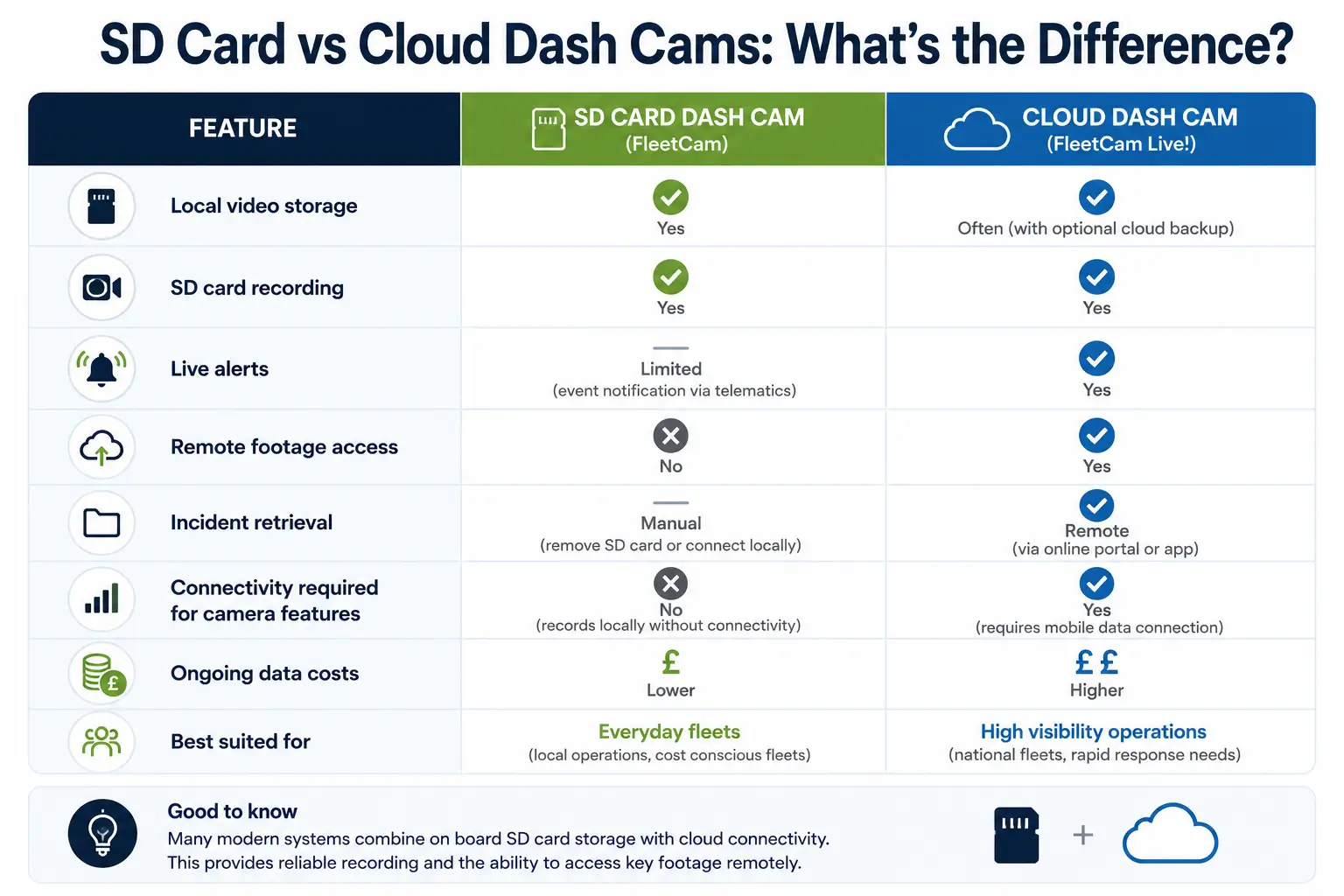
Importantly, these technologies are not mutually exclusive.
Many modern systems combine on board storage with cloud connectivity, providing both reliable recording and remote access.
Which fleets suit each technology?
SD card systems are often ideal for:
- Local delivery fleets
- Trades and service vehicles
- SMEs
- Cost conscious operators
Cloud connected cameras may be better suited to:
- National fleets
- HGV operators
- High value assets
- Businesses requiring rapid incident response
- Operators with remote management teams
The right choice often comes down to how quickly footage needs to be accessed and how much visibility fleet managers require.
Fleet dash cams do more than record incidents
Modern fleet cameras are no longer simply about capturing collisions or close calls.
When integrated with telematics platforms, they can help businesses:
- Monitor driver behaviour
- Reduce accident risk
- Improve driver coaching
- Investigate complaints
- Strengthen security
- Improve fleet oversight
Combined camera and tracking solutions provide a more complete picture of fleet operations, helping businesses improve both safety and efficiency.
When a forward facing camera isn’t enough
For some fleets, a single forward facing camera only tells part of the story.
Operators of HGVs, buses, waste vehicles and urban delivery fleets often need visibility around the entire vehicle, particularly when operating in busy environments with vulnerable road users.
That is where multi camera systems come into their own.
Solutions such as FleetCam 360° provide full vehicle visibility using multiple cameras positioned around the vehicle. This can help businesses:
- Reduce blind spots
- Improve driver awareness
- Support vulnerable road user safety
- Investigate incidents from multiple angles
- Strengthen compliance and risk management
For businesses operating larger vehicles or working in urban environments, 360° visibility can provide an additional layer of protection for both drivers and the public.
Finding the right solution
There is no single “best” fleet camera.
The right solution depends on your fleet size, operational risks, security requirements and reporting needs.
At Fleetloc8, businesses can choose from a range of camera solutions, including FleetCam for on board SD card recording, FleetCamLive! for live connectivity and remote footage access, and FleetCam 360° for complete vehicle visibility.
Whether you need straightforward video evidence, real time monitoring or full vehicle coverage, selecting the right technology can help improve safety, protect drivers and provide greater peace of mind.
To find out more about Fleetloc8 camera solutions, speak to the Fleetloc8 team today on 01698 515 104.
