

Understanding driving scores
Driving scores explained article by Jamie Drummond, Sales Manager at Fleetloc8, the Fleetmaxx Tracking Solution.
A driving score turns a lot of information about what happens on the road into one simple number. That makes it easy for a busy fleet manager to see where performance is strong and where there may be room for improvement.
But the number is only the starting point.
Used well, a driving score can help you spot risk, reduce unnecessary fuel use and start better conversations with your drivers. Used without context, it can create unfair comparisons or make people feel they are being judged by a dashboard.
At Fleetloc8, we believe driver data should help you coach and improve, not catch people out. Here is what a driving score measures, how Fleetloc8 calculates it and how to use it fairly across your fleet.
What is a driving score?
A driving score, also known as a driver score, is a rating based on driving behaviour recorded by a vehicle tracking or telematics system.
Instead of asking a fleet manager to examine every journey and event individually, the system brings several measurements together into a score. This provides a quick overview of recorded performance and makes it easier to identify trends.
Fleetloc8 presents each driver with a score from 1 to 100. The score draws on several types of journey and driving data, giving managers a consistent way to review performance across their fleet.
It is important to remember what that score is and what it is not. It is a summary of recorded driving behaviour. It is not a complete judgement of a driver’s ability, attitude or professionalism.
How is a driving score calculated?
There is no universal formula for calculating a driving score. Different telematics providers may measure different behaviours, apply different weightings or use different scoring scales.
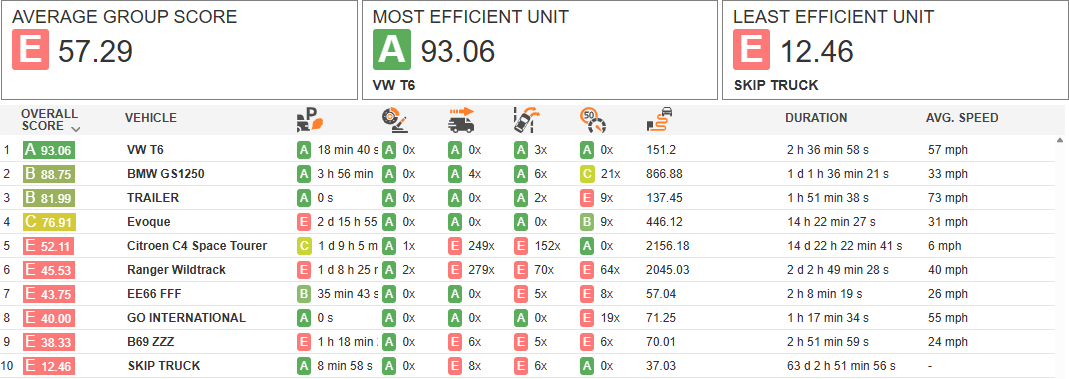
Fleetloc8’s EcoDrive function calculates its driver score using:
- Idle time
- Harsh braking
- Harsh acceleration
- Harsh cornering
- Overspeeding
- Overall distance travelled
- Overall driving time
These measurements help build a picture of how a vehicle is being driven and used.
Harsh braking, acceleration and cornering can highlight driving that may increase road risk, fuel consumption or vehicle wear. Overspeeding data can identify occasions when a driver exceeds a set speed threshold. Idle time shows when an engine is running unnecessarily, which can waste fuel and increase emissions.
Distance and driving time add important context. A driver who spends all day on the road and covers hundreds of miles naturally has more opportunities to record an event than someone who makes one short journey. Looking at activity alongside time and distance makes the resulting score more meaningful than a simple total of recorded events.
The precise calculation should be left to the system. Fleet managers do not need to work out the score themselves; their attention is better spent understanding the patterns and events behind it.
Why do driving scores matter to a fleet?
Most fleet managers already have plenty of information available to them. The real challenge is finding the information that needs attention without spending all day looking through reports.
A driving score gives you a useful place to begin. It can help you:
- Identify recurring driving risks
- Find drivers who may benefit from support or refresher training
- Recognise consistently safe and efficient performance
- Reduce avoidable idling and fuel use
- Highlight behaviour that may contribute to tyre, brake and vehicle wear
- Monitor whether coaching is leading to improvement
- Support fleet safety and compliance reporting
This is particularly valuable when you manage several vehicles or drivers. Rather than waiting for a complaint, a collision or an unexpected rise in costs, you can use the data to spot developing trends earlier.
What is a good driving score?
The most useful answer is not a single number. A good score is one that reflects safe, efficient driving within the scoring system you use. The direction of travel matters too.
For example, a driver whose score improves steadily following coaching is giving you useful evidence of progress. That may be more meaningful than comparing two drivers who operate different vehicles, carry different loads or work on very different routes.
When reviewing Fleetloc8 driver scores, compare like with like wherever possible. Consider:
- The type and size of vehicle
- The driver’s role
- Typical journey length
- Urban, rural or motorway driving
- Traffic and road conditions
- Payload and operating environment
- Performance over time
A city centre delivery driver may encounter more stop-start traffic and potential braking events than somebody covering long motorway routes. The score helps bring attention to a pattern, but a fair review still needs an understanding of the job.
What can affect a driving score?
The behaviours measured by Fleetloc8 all have a part to play.
Unnecessary idling can affect efficiency, while repeated harsh acceleration may use more fuel and add strain to the vehicle. Harsh cornering and braking can indicate a lack of anticipation or insufficient space. Overspeeding can create obvious safety, legal and reputational risks for a business.
However, not every recorded event tells the whole story.
A harsh-braking event might mean a driver was following too closely. It might also mean they reacted correctly when another road user pulled out in front of them. One event should prompt a review, not an immediate conclusion.
That is why I always encourage fleet managers to look for patterns. One isolated event is very different from repeated harsh braking across several journeys.
What can’t a driving score tell you?
A driving score can tell you what the tracking system recorded. On its own, it may not tell you why it happened.
This is where the wider Fleetloc8 information becomes useful. Trip history, route playback, event details and the time and location of an incident can help a manager understand the circumstances behind the score.
Where a fleet also uses a vehicle camera solution, footage may provide further context. It can help distinguish between risky driving and a reasonable response to something unexpected on the road.
The best decisions come from using the score as a signpost and then reviewing the supporting evidence.
How to use driving scores fairly
Drivers are more likely to engage with telematics when they understand what is measured and how the information will be used. A transparent approach makes the score a coaching tool instead of something to fear.
I recommend five straightforward steps:
- Explain the system. Tell drivers which behaviours contribute to the score and why the business monitors them.
- Establish a baseline. Review normal fleet performance before setting targets or drawing conclusions.
- Look for patterns. Focus on repeated behaviours and changes over time rather than reacting to one event.
- Discuss the evidence. Give the driver an opportunity to explain the journey or circumstances.
- Recognise improvement. Use the system to highlight good and improving performance, not only problems.
This approach gives managers better information while helping drivers see a practical benefit. It turns the conversation from “your score is poor” into “this is the pattern we can work on together.”
How can drivers improve their driving score?
The habits that support a stronger driving score are generally the same habits that support safer, smoother and more economical driving:
- Leave enough distance from the vehicle ahead
- Accelerate progressively
- Read the road and anticipate junctions, traffic and changing signals
- Brake smoothly and in good time
- Take corners at an appropriate speed
- Follow posted speed limits and company policies
- Switch off the engine when it is safe and practical instead of idling unnecessarily
- Review recurring events with a manager and act on coaching
Improvement does not need to happen overnight. Tracking performance over time lets managers and drivers see whether small changes are having an effect.
Turning a score into better fleet performance
The real value of a driving score is not the number itself. It is what you do next.
Fleetloc8 gives managers a score from 1 to 100 based on idle time, harsh braking, harsh acceleration, harsh cornering, overspeeding, overall distance and driving time. This provides a clear overview, while the supporting tracking data helps you investigate what sits behind it.
Use that insight to have informed conversations, focus training where it is needed and recognise drivers who are doing a good job. When drivers understand that the aim is safer, more efficient performance, not surveillance, the data becomes far more useful to everyone.
If you would like to see how Fleetloc8 can help you monitor driver performance and manage your vehicles more effectively, speak to our team.

Frequently asked questions
What is the Fleetloc8 driver score range?
Fleetloc8 scores each driver on a scale from 1 to 100. The score summarises several aspects of recorded driving behaviour alongside overall distance and driving time.
Does driving distance affect your Fleetloc8 driver score?
Yes. Overall distance and driving time are included in the Fleetloc8 driver score calculation. This places driving events in the context of the driver’s overall activity rather than relying only on raw event totals.
Is a driver score the same across every telematics system?
No. Providers may measure different behaviours, use different weightings and present scores on different scales. Fleet managers should understand how their own system works before comparing results or setting targets.
Should a fleet manager judge a driver by their score alone?
No. A driving score is a useful starting point, but managers should review patterns, journey information and the circumstances behind recorded events. Scores work best as part of a fair, evidence led coaching process.